Front Mounted Winch Recovery Techniques

Attachments

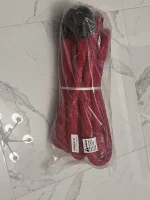
  • IMG_8642.webp
    IMG_8642.webp
    126.1 KB · Views: 78
Last edited:
I'm confused as to why a 12.5k winch is not enough. Perhaps I have always calculated wrong.

That the 2500 truck is 12k GVWR which is surprising. My 3500 Duramax is 12.1k. An AT4X 2500 is 10.6k and If you're mudding or hitting the snow 100% loaded (to get to the 10.6k GVWR), that in itself is wrong.

10.6kGVWR - 3300 payload is a 7300# truck. That gives a 1.7x on a 12.5k winch. More than enough in my opinion.

Is my math/thinking wrong?
 

I'm confused as to why a 12.5k winch is not enough. Perhaps I have always calculated wrong.

That the 2500 truck is 12k GVWR which is surprising. My 3500 Duramax is 12.1k. An AT4X 2500 is 10.6k and If you're mudding or hitting the snow 100% loaded (to get to the 10.6k GVWR), that in itself is wrong.

10.6kGVWR - 3300 payload is a 7300# truck. That gives a 1.7x on a 12.5k winch. More than enough in my opinion.

Is my math/thinking wrong?
Sometimes using a winch is best, sometimes using a static pull is best, or sometimes a kinetic pull is best. I have needed to use pullies and a tree strap to to do a redirect pull, or even a pulley to multiply the pulling power of a winch, as a 12k winch could not pull a dead vehicle "1/2ton silverado" berried to the frame in thick mud dragging axels. All depends on the vehicle that is stuck, how its stuck, and what is needed to get it out. So having multiple options is good. Like i always say, better to have it and not need it then to need it and not have it.
 

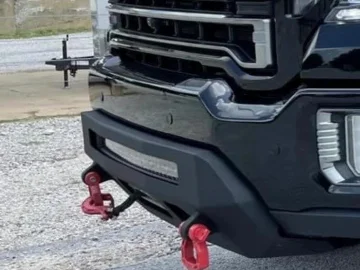
2.5" Factor 55 Shackle Hitch Receiver ordered. A yellow one, huh? it was a choice between grey or yellow and it will look fine with 7/8" red shackles with a 1" shackle pin. Getting there slowly.
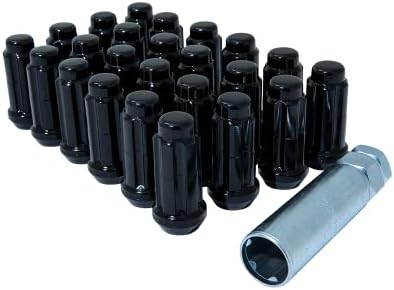
5130Ep7vB1L._AC_SL1089_.webp

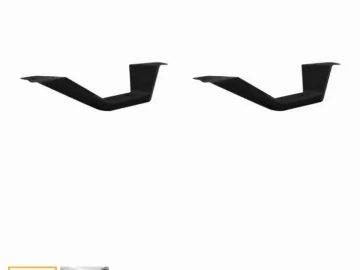
71oGbsrNEKL._AC_SL1500_.webp
 

I'm confused as to why a 12.5k winch is not enough. Perhaps I have always calculated wrong.

That the 2500 truck is 12k GVWR which is surprising. My 3500 Duramax is 12.1k. An AT4X 2500 is 10.6k and If you're mudding or hitting the snow 100% loaded (to get to the 10.6k GVWR), that in itself is wrong.

10.6kGVWR - 3300 payload is a 7300# truck. That gives a 1.7x on a 12.5k winch. More than enough in my opinion.

Is my math/thinking wrong?

Generally speaking, you use GVWR plus some safety factor (I've seen people use anywhere from 1.5-2x) for the winch rating. 3300lb wouldn't be hard with things like a bed rack, 4 people in the truck, coolers full of food, water, roof top tent, etc. 12.5k is probably fine for most people, but for me, I'd rather err on the side of caution.
 

Wow they are not cheap. I have never used them. Are the cheap ones any good? I have used floor mats and wood back in the day.
Knock offs are OK for mild use. They may just break easier and under less uses than the others. I've seen the cheaper ones crack after one or two uses, so if you only are keeping them for that "oh $hit" situation and not likely to use them every weekend the cheap ones may be fine. But if budget allows, the actiontrax and maxtrax have a superior design and better quality.
 

Pinebaron you do like spending money! Get yourself one of these to keep everything in and you can stand on it to get into the engine bay in a pinch.
I like spending money on quality stuff that provides lasting value. I don't fancy putting a pail in the back. Most metal hardware is or will reside under rear seat storage whilst all straps and ropes are in the bed. I'll probably get or build a rack and attach it to the inside right bed wall with hooks or something; at this time straps and ropes are still in their packages. With the thick gmc rubber mat, nothing moves back there. I don't haul anything except personal stuff, fishing gear when going fishing or model planes when going to the club. I have a step ladder I use to get into the engine bay, clean/polish the under and over the hood, windscreen or even the roof.
 

I like spending money on quality stuff that provides lasting value. I don't fancy putting a pail in the back. Most metal hardware is or will reside under rear seat storage whilst all straps and ropes are in the bed. I'll probably get or build a rack and attach it to the inside right bed wall with hooks or something; at this time straps and ropes are still in their packages. With the thick gmc rubber mat, nothing moves back there. I don't haul anything except personal stuff, fishing gear when going fishing or model planes when going to the club. I have a step ladder I use to get into the engine bay, clean/polish the under and over the hood, windscreen or even the roof.
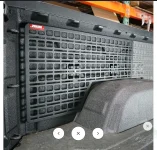
You need this setup bud.
 

Attachments

  • Screenshot_20240925_210036_Chrome.webp
    Screenshot_20240925_210036_Chrome.webp
    367.5 KB · Views: 91
I like spending money on quality stuff that provides lasting value. I don't fancy putting a pail in the back. Most metal hardware is or will reside under rear seat storage whilst all straps and ropes are in the bed. I'll probably get or build a rack and attach it to the inside right bed wall with hooks or something; at this time straps and ropes are still in their packages. With the thick gmc rubber mat, nothing moves back there. I don't haul anything except personal stuff, fishing gear when going fishing or model planes when going to the club. I have a step ladder I use to get into the engine bay, clean/polish the under and over the hood, windscreen or even the roof.
You missed my point. You can use the bucket to stand on in the backcountry when you don't have a ladder. I was thinking the straps and ropes will stay dry in the bucket. They loose capacity when wet. When you get home one thing to take out. Everyone has their own way of doing thinks I get it.
 

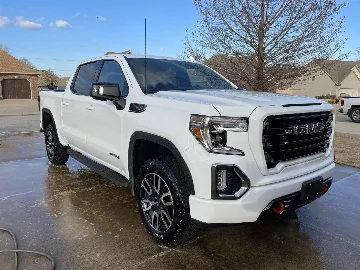
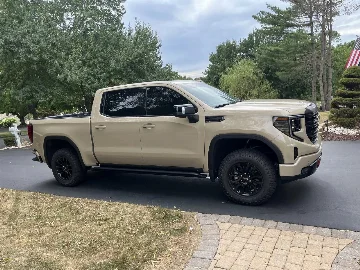
Being a winch noob, and with fall and winter approaching, I want to educate myself on use of the 12500lb front mounted winch on my 2024 2500HD AT4X AEV.
One of my fears is getting front of the truck stuck in mud or snow in a ditch and figuring out how to extract the truck backwards with the front mounted winch.
This is what I found on the internet. I think I'll need several snatch blocks or wheels to make this happen, plus a whole lot of rope. The double line pull at the back will pull the vehicle backwards, despite winch pulling rope in from the front. The Comeup winch has 82' of synthetic rope on it; I need to pull it all out to actually measure it.
How much additional rope and equipment do I need for this?

Experts please chime in for ideas and/or real life experiences.

View attachment 19335
You’re unlikely to every end up in a spot where you have the anchor spots reflected in the above diagram. That’s hopelessly complicated.

A kinetic rope, recovery boards, and a shovel will get you out of 95% of the mud and snow situations unless you were really determined to get yourself stuck. (If you find yourself digging in, stop and consider options before you fully bury the axel).

My winches have been most useful 1) extricating others, 2) tensioning fence, 3) moving trees out of the road/trail, and 4) helping me to climb my truck or jeep through a difficult or especially greasy technical spot.

There are a lot of manufacturers selling crappy knock-off ropes and cheap, brittle recovery boards. Don’t buy them. The best recovery boards are extremely strong, but also flexible. There are situations where maximum traction is only achieved when the board is able to flex to match the curvature of the tire or terrain. The best boards can do that but, when doubled or tripled up, also carry the weight of the vehicle across a hole or ditch. They’re amazing tools.

The best way to travel through sketchy areas is to travel with a buddy or two. It’s more fun with company, and the person lagging behind will always be on firm ground. He’s the energy source for your kinetic rope jerk and, if worst comes to worst, you always have a ride home. 👍

If you decide to venture into the boonies on your own I strongly recommend a Garmin InReach or similar satellite communication device. They’re cheap now, and they’re a lifeline if your best efforts come up a but short. I also carry warm clothes, water, a saw, and fire-making supplies. I’ve seen too many people who are unprepared to be stranded. Nobody wants to be stranded, of course, but it’s no big deal if you can stay warm, dry, and hydrated.
 

Addendun:

1) Recovery gear quickly takes up space and adds weight to your truck, and
2) What you’re likely to need depends on where you are going and who (if anybody) will be with you.

You need to plan/pack for the mission. If several are traveling together you can coordinate to carry more. If you’re alone, think more and plan carefully.

For example, tree-savers and snatch blocks aren’t much help when you’re driving/stuck on the beach/dunes, but a Bubba Rope, shovel, and traction boards are a Godsend. Even if you’re alone, there’s a good chance another rig will be by at some point, so somebody will be able to give you a good yank if you can’t self-extricate with the boards. (Which you almost certainly can, as long as you have a shovel and some time.)

On the other hand, we occasionally travel very muddy, tight, steep, northwest forests in the spring. There are lots of deep, slushy, puddles that are a mix of snow, water, mud, and rocks of every size. The rocks are often up to a foot or more below the surface. Traction boards aren’t helpful in that situation, as they are almost impossible to place between lumpy, mismatched, slippery boulders, especially when you’re trying to position them by feel, and they promptly spin out of position as soon as your first tire spins. The kinetic rope is generally useless in that environment too, as the spaces are too confined and technical, and there’s seldom room to get a good run for a yank. Even when there is room, a hard yank is dangerous because you’re in the middle of boulder-soup, and you might well break something or make your situation worse . The safe solution is a steady pull to help you slowly pick your way out of the hole you’re in. Fortunately, there’s an infinite supply of trees in the forest, so a tree-saver and snatch block is the winner.

The same sort of environmental consideration is useful when deciding what kind of jack to carry. Lots of jeepers carry farm jacks, as I did for nearly 40 years. They’re great tools, but they’re also extremely dangerous, particularly on uneven ground. For me, the best all-around kit is a big bottle jack with extensions and some wood, but in the middle of the dunes/beach or a deep snow field an air/exhaust jack can be a much better tool. (I carry onboard air, so I can air down tires to soften the ride and reduce the likelihood of getting stuck. When I’m out of the greasy stuff I air the tires back up.)

You can’t carry everything for every mission. That’s one of the important lessons young Marine Corps officers learn during training at The Basic School. They’re told not to carry unnecessary trash on their long hump, but many don’t listen, so they start their day overloaded. As the miles add up and fatigue sets in they start dumping gear. (The NCOs used to follow behind them in jeeps, collecting all the gear they discarded on the hump, so they could sell it back to them. 😂)

If I’m with friends we coordinate on recovery gear. More people means more room for contingency gear — like an extra chainsaw, for example. Thinking through this stuff is part of the challenge, and part of the enjoyment.

 

You missed my point. You can use the bucket to stand on in the backcountry when you don't have a ladder. I was thinking the straps and ropes will stay dry in the bucket. They loose capacity when wet. When you get home one thing to take out. Everyone has their own way of doing thinks I get it.
You're right!. Far as wet goes, I have the Diamondback tonneau cover which is pretty much water tight.
 

Back
Top